
Power Energy Generation
Generation of Alternative / Renewable Energy through the establishment of
Solar (PV) Park/s And Solar (PV) Rooftop/s
Introduction
A photovoltaic power station, also known as a solar park, is a large-scale photovoltaic system (PV system) designed for the supply of merchant power into the electricity grid. They are differentiated from most building-mounted and other decentralised solar power applications because they supply power at the utility level, rather than to a local user or users. They are sometimes also referred to as solar farms or solar ranches, especially when sited in agricultural areas. The generic expression utility-scale solar is sometimes used to describe this type of project.
The solar power source is via photovoltaic modules that convert light directly to electricity. However, this differs from, and should not be confused with concentrated solar power, the other large-scale solar generation technology, which uses heat to drive a variety of conventional generator systems. Both approaches have their own advantages and disadvantages, but to date, for a variety of reasons, photovoltaic technology has seen much wider use in the field. As of 2013, PV systems outnumber concentrators by about 40 to 1.
Most of the existing large-scale photovoltaic power stations are owned and operated by independent power producers, but the involvement of community- and utility-owned projects is increasing. To date, almost all have been supported at least in part by regulatory incentives such as feed-in tariffs or tax credits, but as levelized costs have fallen significantly in the last decade and grid parity has been reached in an increasing number of markets, it may not be long before external incentives cease to exist.
M3 Holdings with its core business as an energy services company has diversify into related renewable energy generation markets. In order to create a significant presence in the renewable energy space and become a prominent player in the short term, M3 opted to align its business with reputable international development funding and technology partners with a mandate to build and operate renewable energy assets in Africa. M3 have particularly aligned itself with partners that are primarily in the business of developing Solar Parks to generate renewable energy from the sun. Together with these partners, M3 Holdings endeavour sourcing the funds, develop, run and maintain these Solar Parks as an Independent Power Producer (IPP). M3 Holdings have in the meantime registered the partnership and entered into a MOU with the South African Government’s Department of Energy’s IPP Office. The intention of this partnership is to primarily provide the African market with an alternative energy generation and of course sell the electricity generated to various clients through public private partnerships.
The M3 partnership has identified utilities as potential strategic alliance partners. The proposed Solar Park/s development within these areas are intended to provide an integrated and concentrated zone of development comprising of a mix of solar PV and other solar technologies and generate power for delivery to the local and/or national grid for purposes of providing sustainable electricity supply to communities.
Preliminary investigations indicate that envisaged sites being considered must preferably have a high yield of irradiation and is capable of producing in excess of 0.9TWh of renewable energy annually, with a nominal net generating capacity of between 5 to 500 MW per month, based on solar PV technology and the current demand criteria.
We are absolutely sure that utilities will find the reasons for such a proposal to be exceptionally beneficial with multiple advantages to both the utility and the community. We highlight therefore a few benefits:
- Enable the utility to become a self-sufficient power generation entity;
- “GREEN POWER” reduces the effects of Global Warming;
- Reduce carbon emissions;
- Mitigate punitive peak load charges from the state distributor;
- Reduce dependency on external generating power producers thereby mitigating against operational disruptions;
- Sustainable decent job creation;
- Create a new revenue stream; Improve the skills profile of community members (young local talent) within their area (available labour); and
- Solar Energy: –
- Eliminates outages, pollution and the perceived high cost of maintenance;
- Reduces cost over time which allows the end user to benefit; and
- Creates a more cost-effective way of Electrification.
Herewith some pertinent characteristics of a Solar Power Park Development: –
- Provide an integrated and concentrated zone of development
- Comprising of a mix of solar PV and other solar technologies
- Generate power for delivery to the local and/or national grid
- Produce a nominal net generating capacity of between 5 to 500MW per month
- Based on PV technology and the current demand criteria
Siting and land use
The land area required for a desired power output varies depending on the location and on the efficiency of the solar modules the slope of the site and the type of mounting used. Fixed tilt solar arrays using typical modules of about 15% efficiency on horizontal sites, need about 1 hectare/MW in the tropics and this figure might rise to over 2 hectares.
Because of the longer shadow the array casts when tilted at a steeper angle, this area is typically about 10% higher for an adjustable tilt array or a single axis tracker, and 20% higher for a 2-axis tracker, though these figures will vary depending on the latitude and topography.
The best locations for solar parks in terms of land use are held to be brown field sites, or where there is no other valuable land use. Even in cultivated areas, a significant proportion of the site of a solar farm can also be devoted to other productive uses, such as crop growing or biodiversity.
Technology
Most Solar parks are ground mounted PV systems, also known as free-field solar power plants. They can either be fixed tilt or use a single axis or dual axis solar tracker. While tracking improves the overall performance, it also increases the system’s installation and maintenance cost. A solar inverter converts the array’s power output from DC to AC, and connection to the utility grid is made through a high voltage, three phase step up transformer of typically 10kV and above.
Solar array arrangements
The solar arrays are the sub-systems which convert incoming light into electrical energy. They comprise a multitude of solar modules, mounted on support structures and interconnected to deliver a power output to electronic power conditioning subsystems. Minorities of utility-scale solar parks are configured on buildings and so use building-mounted solar arrays. The majority are ‘free field’ systems using ground-mounted structures usually of one of the following types:
- Fixed arrays
Many projects use mounting structures where the solar modules are mounted at a fixed inclination calculated to provide the optimum annual output profile. The modules are normally oriented towards the Equator, at a tilt angle slightly less than the latitude of the site. In some cases, depending on local climatic, topographical or electricity pricing regimes, different tilt angles can be used, or the arrays might be offset from the normal East-West axis to favour morning or evening output. A variant on this design is the use of arrays, whose tilt angle can be adjusted twice or four times annually to optimise seasonal output. They also require more land area to reduce internal shading at the steeper winter tilt angle. Because the increased output is typically only a few percent, it seldom justifies the increased cost and complexity of this design.
- Dual axis trackers
To maximize the intensity of incoming direct radiation, solar panels should be orientated normal to the sun’s rays. To achieve this, arrays can be designed using two-axis trackers, capable of tracking the sun in its daily orbit across the sky, and as its elevation changes throughout the year.
These arrays need to be spaced out to reduce inter-shading as the sun moves and the array orientations change, so need more land area. They also require more complex mechanisms to maintain the array surface at the required angle. The increased output can be of the order of 30% in locations with high levels of direct radiation, but the increase is lower in temperate climates or those with more significant diffuse radiation, due to overcast conditions. For this reason, dual axis trackers are most commonly used in subtropical regions.
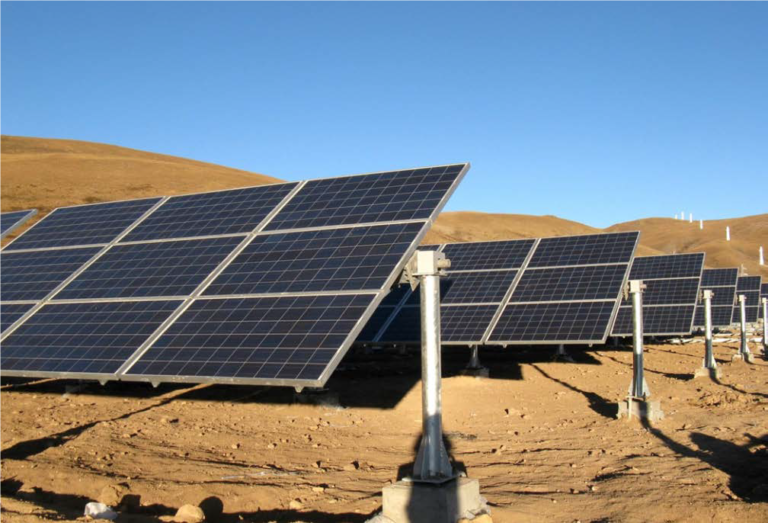
The picture below portrays a horizontal Single Axis Tracking System
- Single axis trackers
A third approach achieves some of the output benefits of tracking, with a lesser penalty in terms of land area, capital and operating cost. This involves tracking the sun in one dimension – in its daily journey across the sky – but not adjusting for the seasons. The angle of the axis is normally horizontal, though some which have a 20° tilt incline the axis towards the equator in a north-south orientation – effectively a hybrid between tracking and fixed tilt.
Single axis tracking systems are aligned along axes roughly North-South. Some use linkages between rows so that the same actuator can adjust the angle of several rows at once.